
Beware of AI
AI can be useful in many ways, but it also involves risks. Whether you use AI yourself or not, it is important to be aware of its possible downsides. Below you find an overview of things that can go wrong and of situations where you should pay extra attention.

Understanding AI risks: mistakes
What can go wrong?
AI can seem smart and capable of doing almost anything. It can write texts, answer questions and create images.
But AI can also make mistakes. This is important to remember, because AI often presents its answers in a confident way, even when the information is incorrect.

Why does AI make mistakes?
Incorrect data:
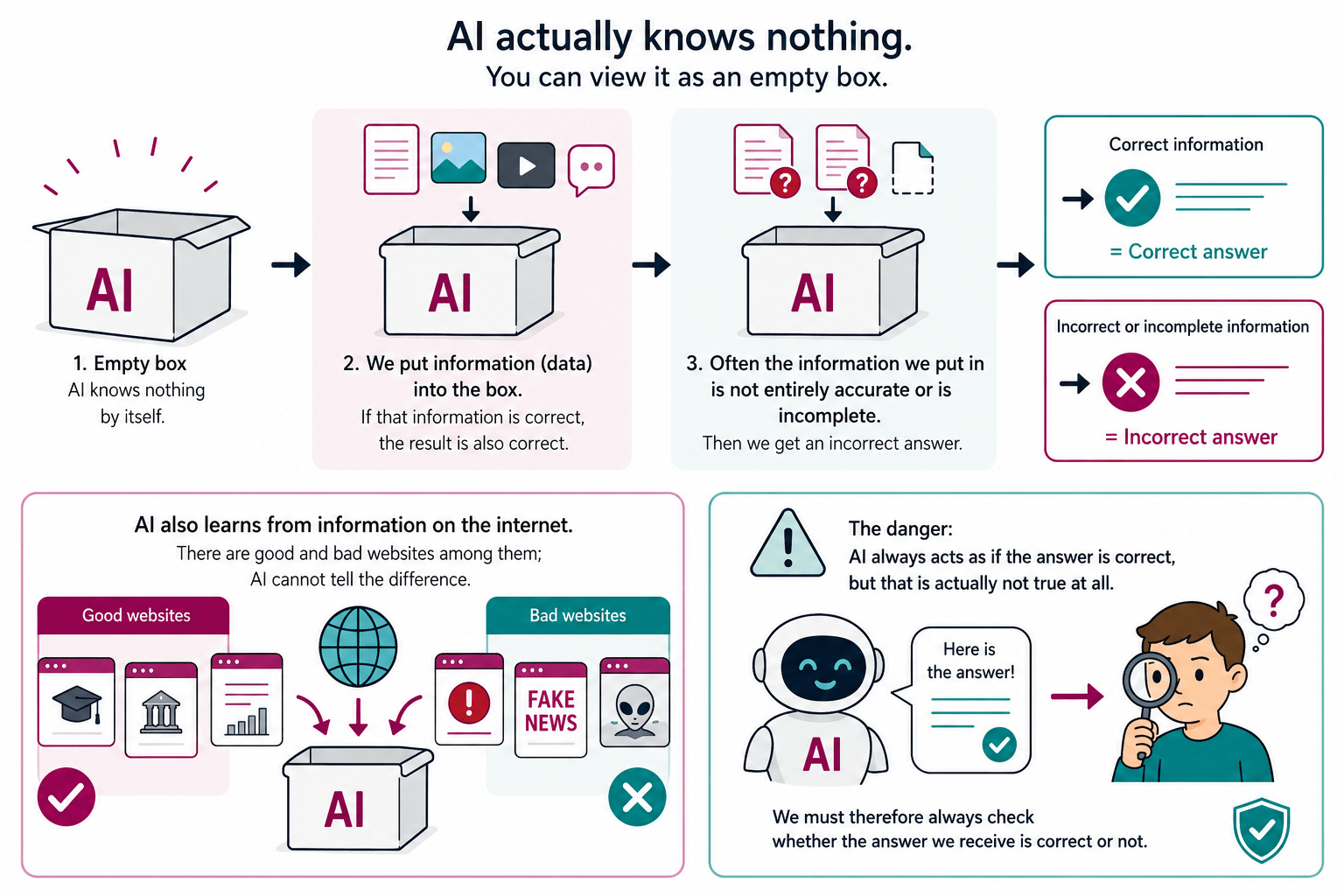
AI can seem as if it knows a lot, even everything. But AI does not truly understand information in the way people do. You can compare it to an empty box that first needs to be given information or data in order to work.
If the data is correct, relevant and reliable, the result is more likely to be useful. But if the data is incomplete, one-sided or incorrect, AI can also give a poor or incorrect answer.
AI systems can also learn from information found on the internet. That information is not always reliable. Some websites are trustworthy, while others contain mistakes, outdated information or misleading content. AI does not always know the difference.
The risk is that AI often presents its answer with confidence, even when the answer is wrong. This is why it is important to check the information with a reliable source.
Bias:
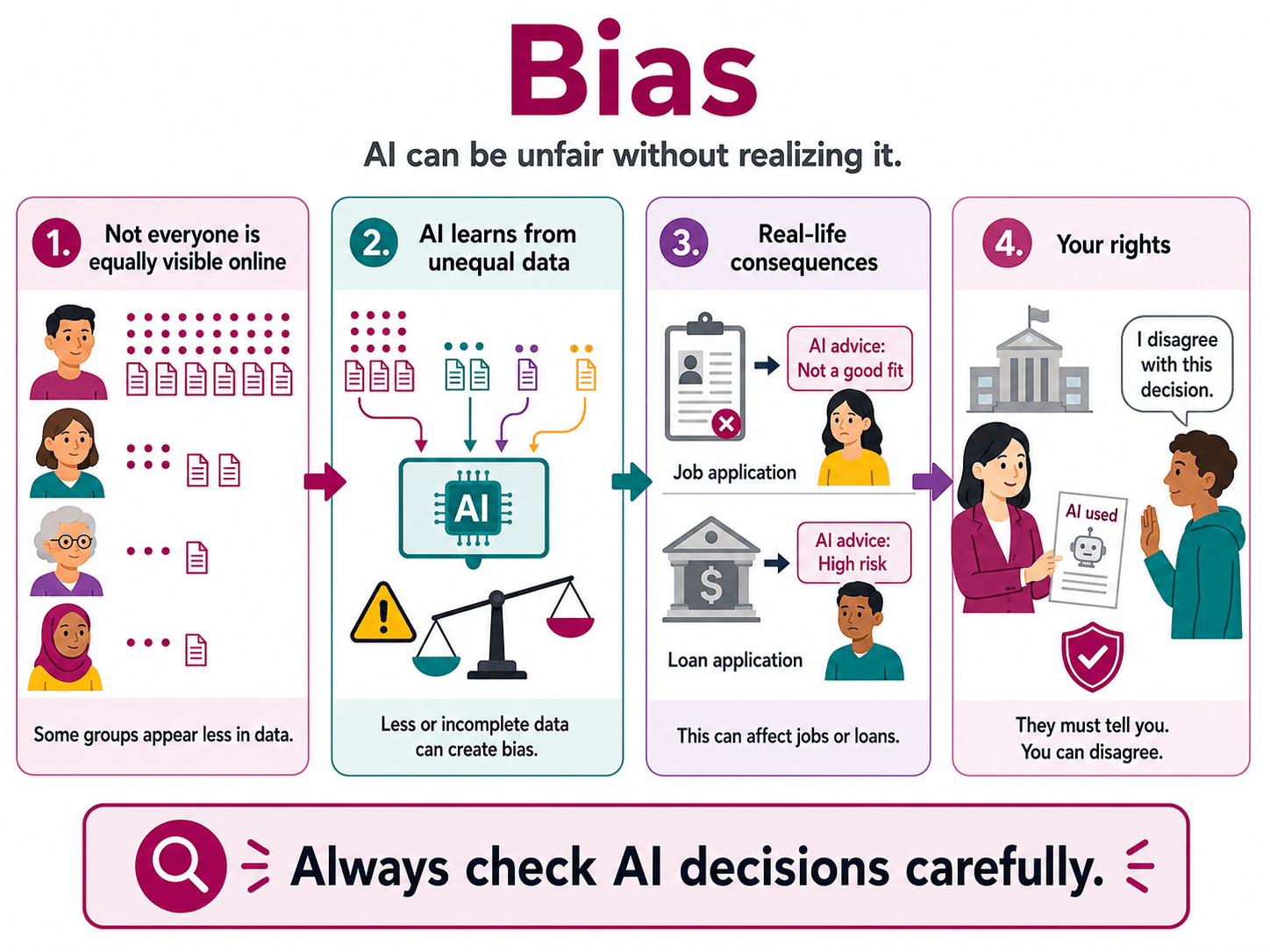
Not everyone is represented in data in the same way. Some groups of people are less visible online or are described in a one-sided way. This can affect how an AI system learns and what results it gives.
As a result, AI can sometimes treat people unfairly, for example based on gender, origin, age, disability or other personal charatheristics. We call this bias. Bias means that the system gives unequal or unfair results.
This can have real consequences, for example when AI is used in recruitment, educations, access to services or financial decisions. If an organisation uses AI to support an important decision about you, it should be clear that AI was involved. In some situations, you also have the right to ask for an explanation and have the decision reviewed by a person.
Hallucinations: AI invents information
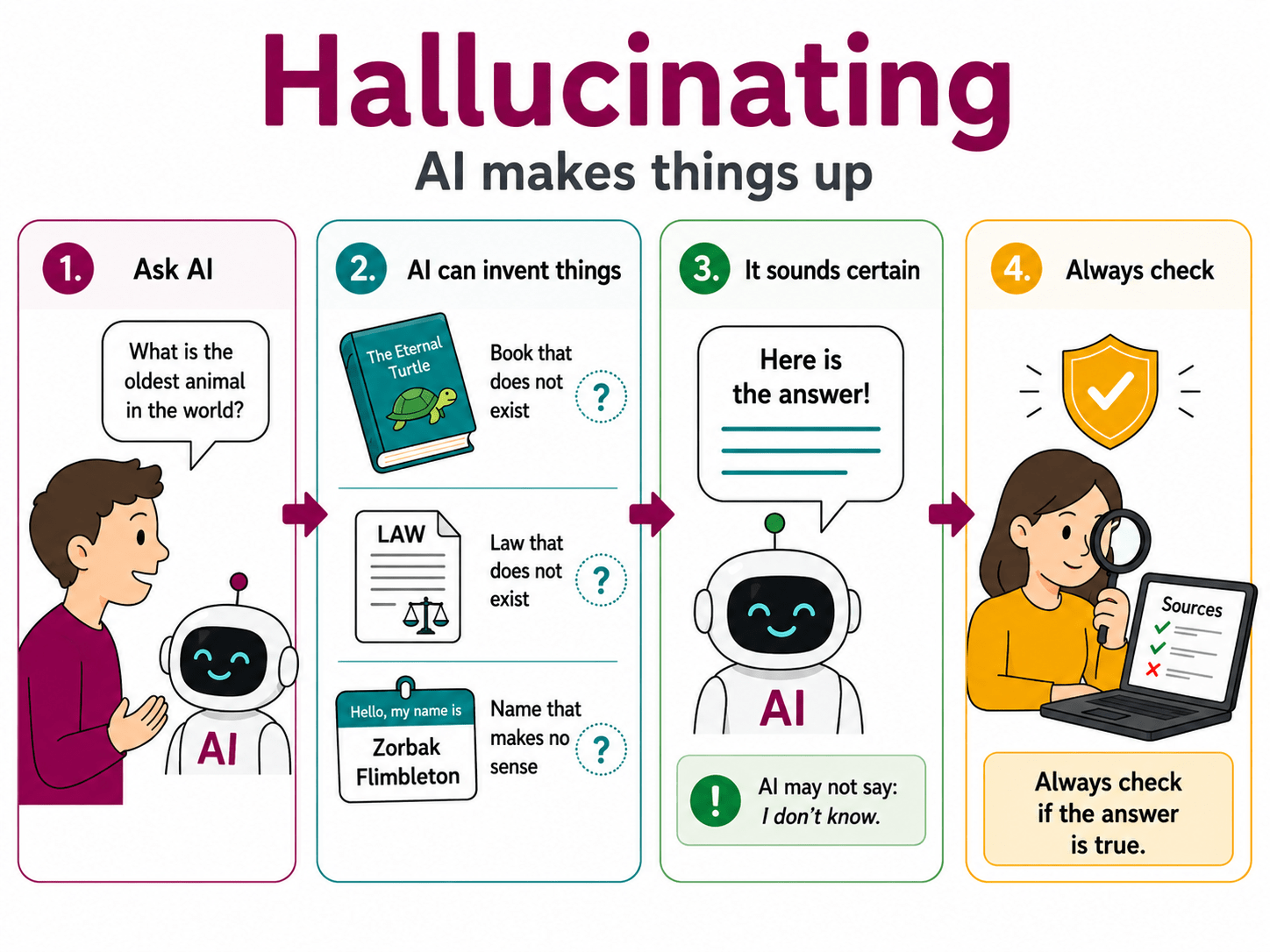
AI can also make up information that does not exist. It may invent a book that was never written, a law that does not exist, a source that cannot be found or a name that is not real. This is called a hallucination.
The difficult thing is that AI can present this invented information as if it is completely correct. It may not say “I don’t know”. Instead, it may simply give an answer that sounds convincing.
That is why it is important to stay critical. Even when an AI answer sounds clear and logical, it should be checked when the information is important.
Infographic is created by AI
Infographic is created by AI
Infographic is created by AI
Understanding AI risks: dependency
AI helps you, you stay in control
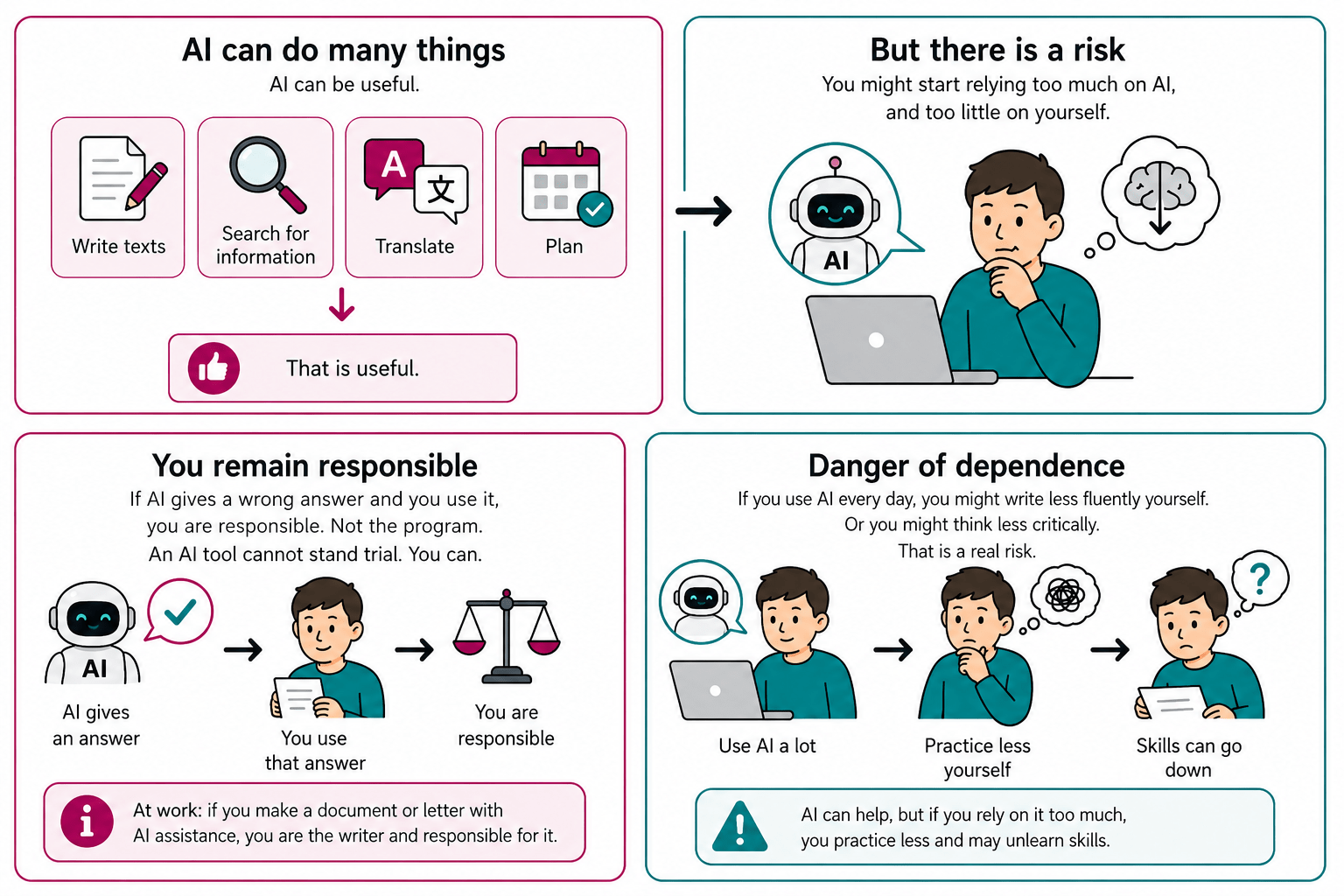
AI can do many things. It can help you write texts, search for information, translate, plan and organise ideas. This can be very useful.
At the same time, there is a risk that you start to rely too much on AI and too little on yourself. AI can support your thinking, but it should not replace it. It’s important to keep using your own judgement, experience and critical thinking.

You remain responsible
If AI gives a wrong answer and you use that answer, you remain responsible. The responsibility does not lie with the AI tool. An AI system cannot be held accountable in the same way a person can.
The same applies at work. If you use AI to help you write a document, email or letter, you are still the author of the final text. You are responsible for checking whether the information is correct, appropriate and complete.
Risk of dependency
There is also a risk of becoming too dependent on AI. For example, if you use AI every day to write emails, you may gradually practise your own writing skills less. You may also become less used to thinking critically about the content.
AI can be a useful assistant, but it should not take over tasks that you can still do yourself. If you rely on AI too often, you practise your own skills less. Over time, this can weaken certain skills, such as writing, problem-solving or making your own judgement.
AI can support you, but it should not replace your own thinking and abilities.
Infographic is created by AI
Understanding AI risks: privacy
Privacy and GDPR: be careful with your data
When you ask a question in an AI tool such as ChatGPT, you share information with that tool That information is sent to the company or organisation that provides the AI system.
Some AI tools may store what you type. This can include names, phone numbers, company information, health information or details about a personal situation. In some cases, the information you enter may also be used to improve or train the AI system.
That is why you should be careful with what you share. Do not enter personal, confidential or sensitive information unless you are sure how the tool handles your data.
Before using an AI tool, it is important to check its privacy settings and terms of use. These explain what happens to your information, where it may be stored and whether it can be used for training.
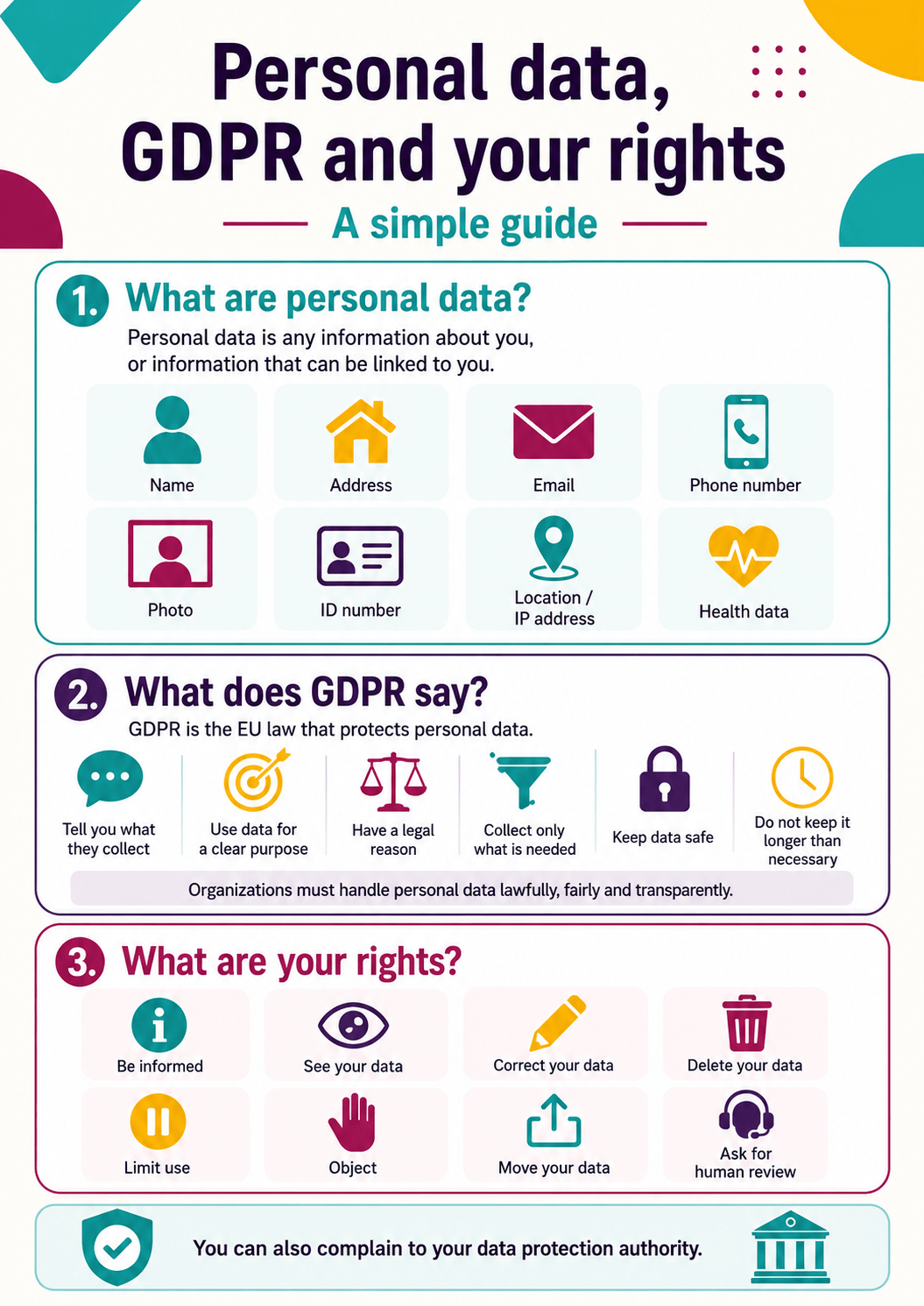
Infographic is created by AI
Be careful with AI and personal data
Never enter sensitive information into an AI tool if you are not sure what happens to that information. Do not share names, medical information, addresses, phone numbers, national register numbers or bank details.
If you want to use your CV in an AI tool, remove your personal details first. You can also take a photo of your CV without showing information such as your full name, address, phone number or email address.
Many free AI tools may use what you type to improve their systems. That is why it is important to check the privacy setting before you use them.
This Youtube-video explains how you can change your settings in ChatGPT to use it more safely.
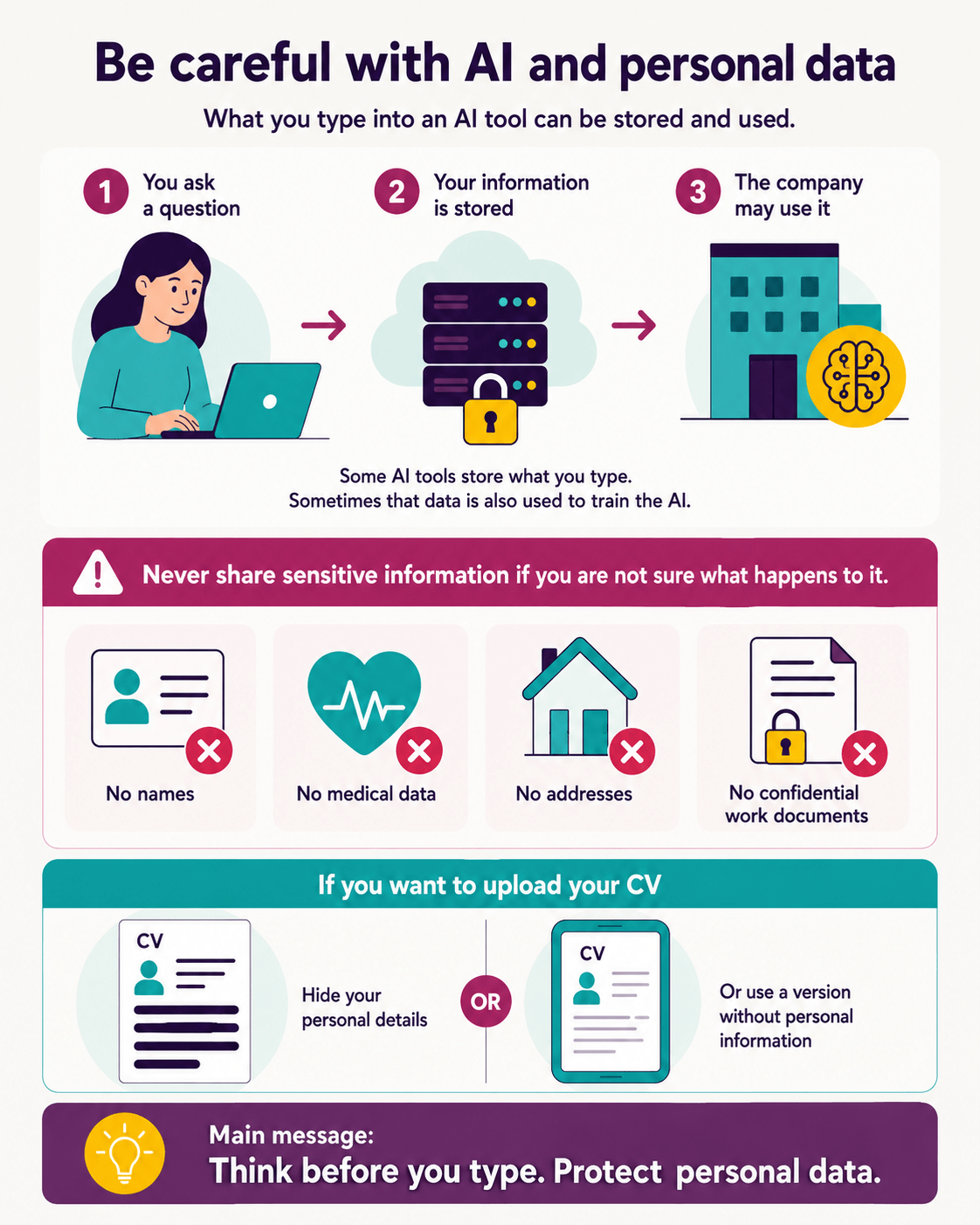
Infographic is created by AI
Understanding AI risks: Abuse
Use AI in a good way
AI is a powerful tool. You can compare it to a knife: useful in the kitchen, but dangerous when it is used incorrectly.
There are things you should not do with AI. In Europe, there are also rules about how AI may and may not be used.
Manipulation and deepfakes
AI can create texts, photos and videos that look real. For example, someone can make a fake video of a politician saying something they never said. Or a fake photo of a person in a situation that never happened.
This can be very harmful. It can damage someone’s repuation, spread false information or mislead many people. It’s also becoming easier to create this kind of content.
Never use AI to mislead people, misuse someone’s identity or spread false information. This is not only wrong, it can also have legal consequences. AI technology is improving quickly. Today, it is becoming more difficult to see the difference between real and fake content.
Real or AI?
AI-generated images can look suprisingdly realistic. In a short quiz made by Britannica Education, you can compare two images and decide which one is real. Look carefully at details such as hands, reflections, lighting, textures and unusual shapes.
Tip! Do not rely only on your first impression. Observe, compare and check the facts. How many AI images can you recognise?
Will you take the test too? Real or AI Quiz: Can You Tell the Difference? – Britannica Education Blog
The European AI Act
The European Union has adopted a law on artificial intelligence: the EU AI Act. This law divides AI systems into different risk categories, from low risk to unacceptable risk.
Some AI practices are prohibited because they are considered too dangerous. For example, AI may not be used to manipulate people without their knowledge. Social scoring systems, where people are given a score based on their behaviour or personal characteristics (like in China), are also prohibited.
Other AI systems are allowed, but must follow strict rules. This applies to high-risk AI systems, for example when AI is used in decisions about work, education, access to public services or essential financial services such as loans.
In these situations, organisations must use AI in a transparent and responsible way. People should be informed when AI is used in decisions that affect them. In certain cases, they also have the right to receive an explanation of the decision and to challenge it.
Important decisions should not be left entirely to AI. Human oversight must remain possible, especially when the decision can have a serious impact on someone’s life.
In short: the EU AI Act is a European law about AI.
Some uses of AI are not allowed. For example, AI cannot be used to secretly manipulate people. AI also cannot be used to give people a social scoring. Other uses of AI are allowed, but only with strict rules. This is important when AI is used for decisions about work, school, public services or loans. Organisations must be clear when they use AI. A person must still be able to check important decisions.
Understanding AI risks: ecological footprint
AI consumes a lot of energy
AI may seem invisible. You type a question and you get an answer. But behind the screen, large computers are working to create that answer. These computers are called servers. They use a lot of energy.
Building and training AI systems also takes a lot of electricity. It can also use a lot of water, for example to cool the computers. So AI is digital, but it still has an impact on the environment.
How much energy does AI consume?
AI uses a lot of electricity because it runs in data centres. These are large buildings full of powerful computers that have to work day and night.
Because these computers produce a lot of heat, data centres need cooling systems. Some of these systems also use water.
Training large AI systems also has an environmental impact. For example, the training of GPT-3 is estimated to have produced about 552 tonnes of CO2. This is roughly the same as the yearly emissions of 60 to 75 people in Belgium.
The energy use of data centres is increasing quickly. By 2030, data centres worldwide could use about as much electricity as a large country, such as Japan.
AI can be useful, but it also has a cost for the environment.
What can you do?
You don’t have to avoid AI, but it is good to think before you use it. Ask yourself the question: do I really need AI for this? Or can I write this text myself, ask someone or simply look up the information with a search engine?
A simple search uses much less energy than asking an AI tool to generate an answer. This is why it is better to use AI when it truly adds value, not for every small question.
You can also ask your employer, school or organisation which AI tools they use and whether they take sustainability into account.
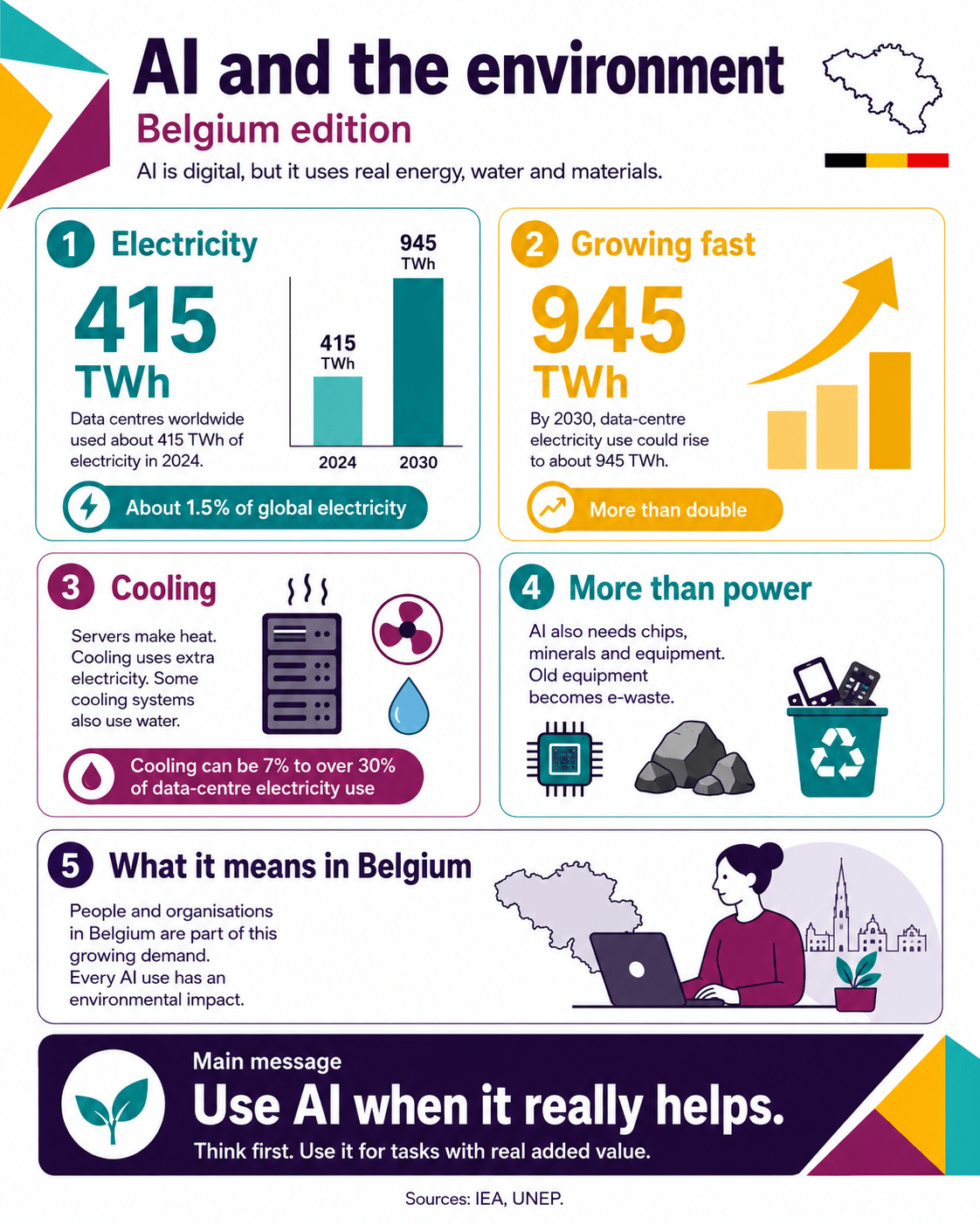
Infographic is created by AI
Learning in a group
Would you rather do it together?
Ask your consultant or coach to use these tools with you. They are happy to help you further.
If you live in or near Brussels and are looking for work, you can also attend a free workshop and register via the button on the right.