
What is AI?
Here you will find general information about artificial intelligence.

Artificial intelligence
What is AI?
What is artificial intelligence?
AI is a technology that enables computers to learn in a way that is similar to how humans learn. AI stands for artificial intelligence. “Artificial” means that something does not occur naturally, but is created or imitated by humans. AI is a new technology that performs tasks in a different way from traditional computer systems.
Traditional computers only follow instructions that have been programmed by humans. AI works differently: an AI system can learn from examples and expierence, in a way that is similar to how humans learns.
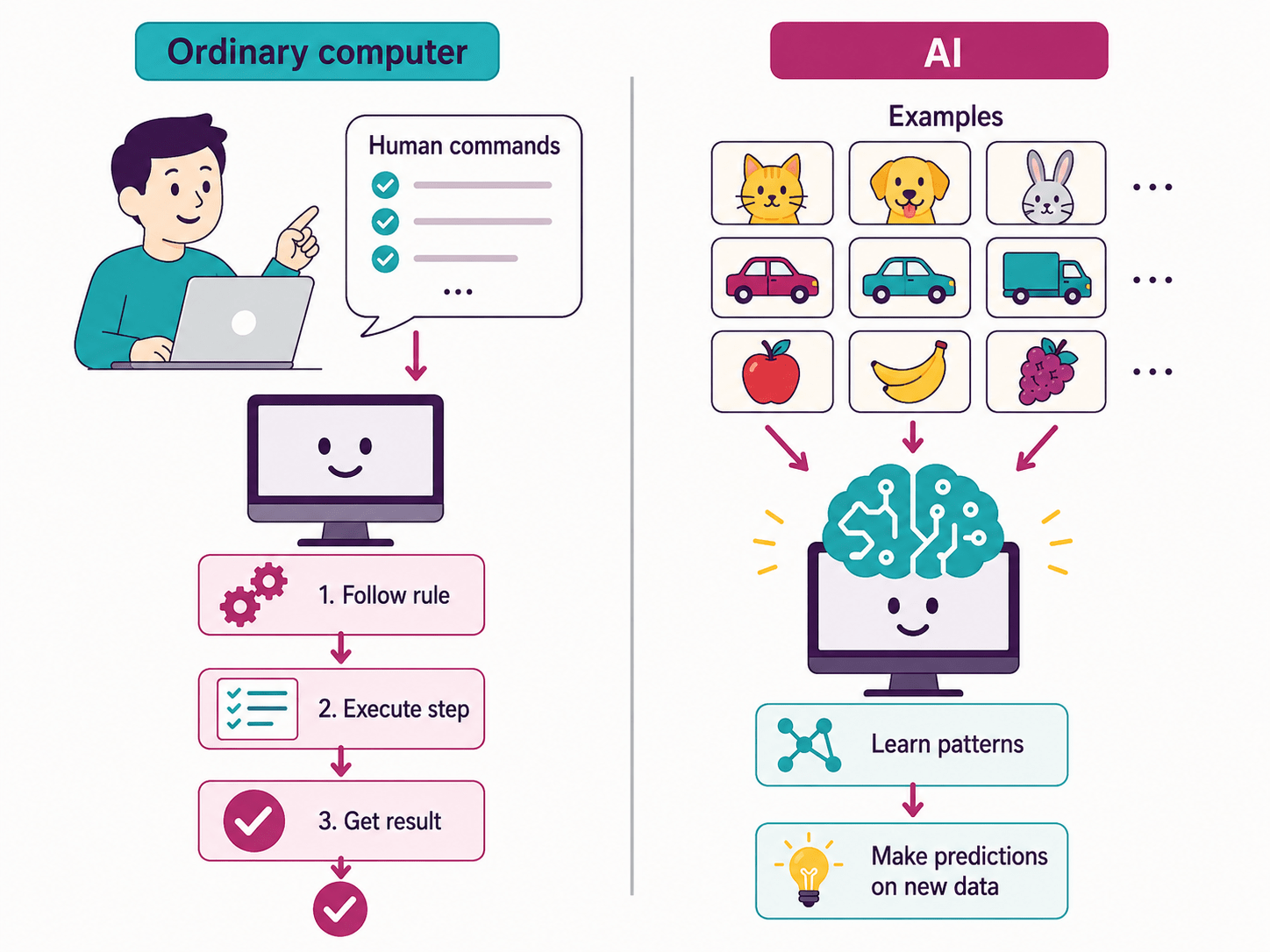
Infographic created with AI
Learning like humans?
Think of a child learning to walk. The child watches how others walk and wants to do the same. No one explains exactly how each muscle should move. The child tries, falls, gets up and tries again.
An AI system learns in a similar way. Instead of giving it fixed rules to follow, you give it many examples, also called data. The AI analyses these examples and look for patterns, similarities and differences.
→ The more good-quality the AI receives, the better it can learn.
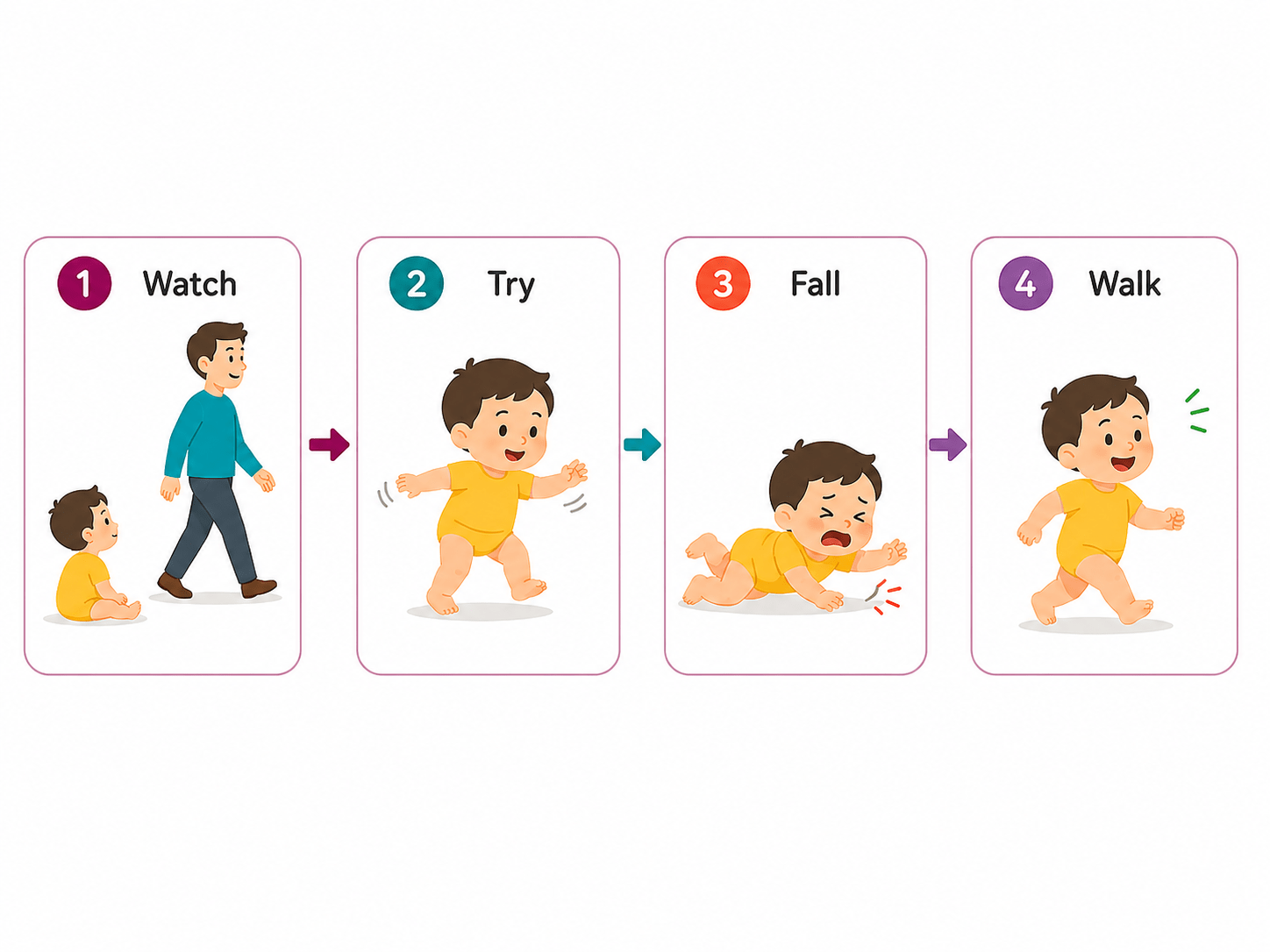
Infographics created by AI
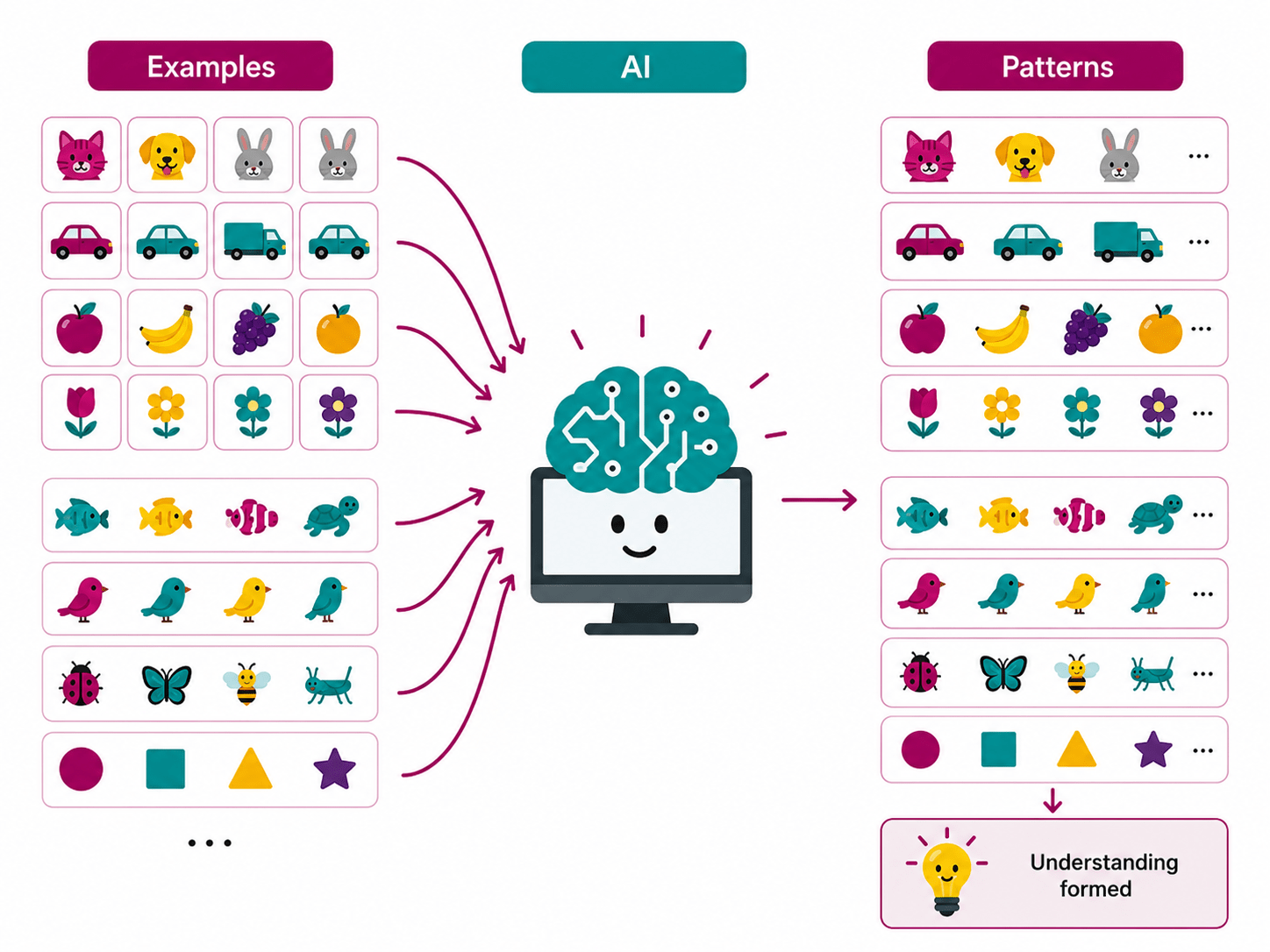
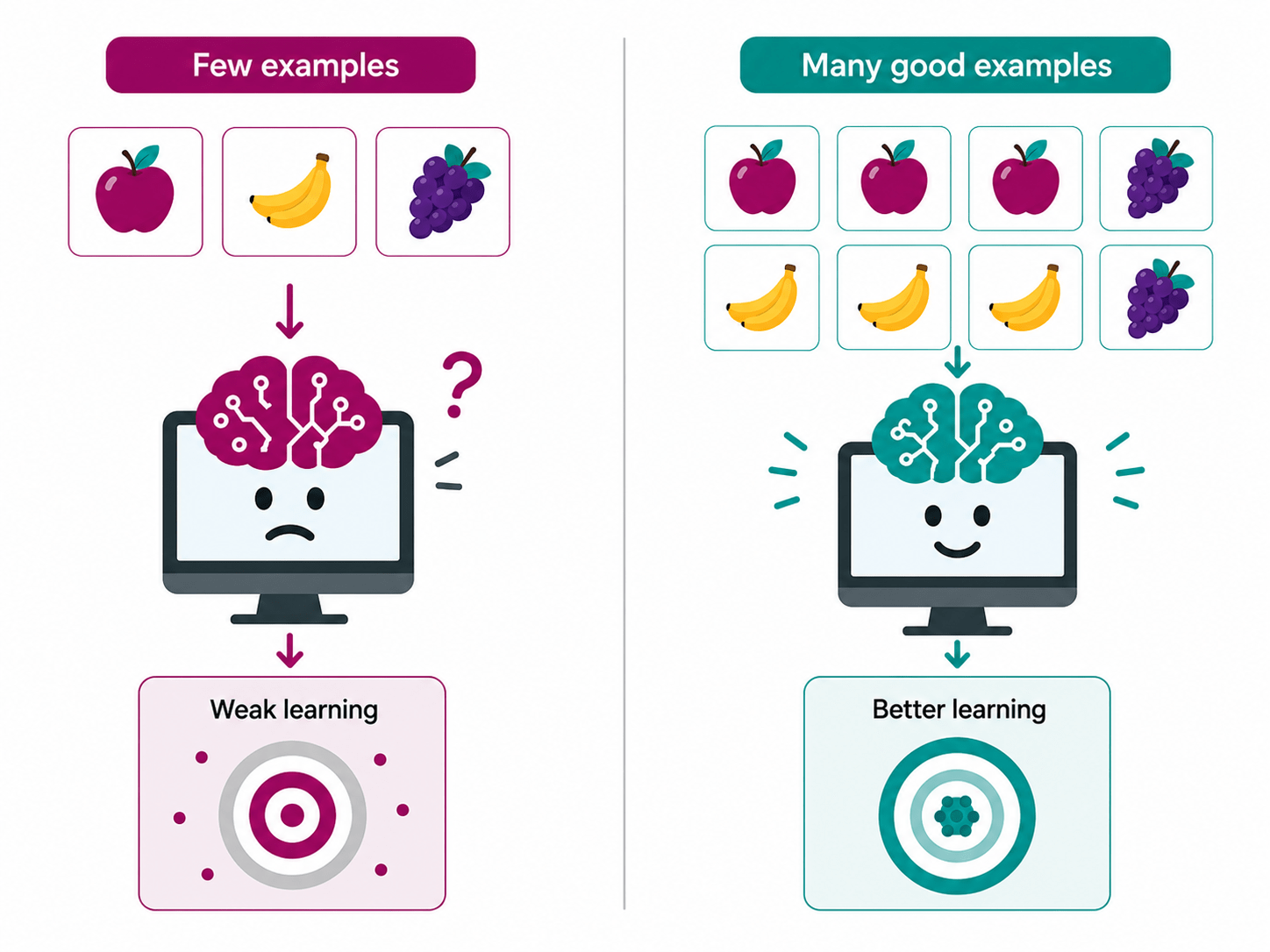
Infographic created with AI
examples
AI is rapidly changing the world: examples of application in different industries
AI is not just ChatGPT or a chatbot. It has been used for years in hospitals, factories, cars and laboratories. Click on an industry to read more.
Health – cancer screening

@Skinvision
An AI system can, for example, help detect skin cancer. To do this, it is first trained with a very large number of photos of skin spots. These photos show both benign and malignant skin lesions. Each photo is given a label, such as ‘suspicious’ or ‘not suspicious’.
By analysing all the examples, the AI systems learns to recognise patterns.
Transport – self-driving cars

Foto: © Jef Van den Bossche
A self-driving car uses multiple AI algorithms simultaneously. Camera’s, radar and laser sencors collect millions of data points about the environment every second: other cars, pedestrians, traffic lights and road markings.
A recognition algorithm recognizes what is around the car. A planning algorithm decides what to do: brake, turn, overtake. Each of those decisions was trained on millions of kilometers of driving data.
Driverless cars are not something of the future: it’s already happening today. Taxis without drivers are already operating in various cities in China and de USA. In Leuven, a pilot project is underway with driverless buses. For the time being however, an attendant is still present to intervene if anything goes wrong.
Would you dare to ride along?
Pharmacy – developing medicines faster
Developing a new medicine often takes ten years or more. First step in the process is finding a substance that helps against a disease and is safe enough for humans.
AI can help researchers understand diseases better. Some AI systems can predict the structure of proteins. Proteins are small components in our bodies that play an important role in how the body works. They can also be involved in the development of diseases.
When researchers know what a protein looks like, they can better understand how it behaves. This helps them search more precisely for medicines that can target that protein.
This can save time in the early stages of research. However, AI does not simply create new medicines on its own. Every medicine still has to go through a careful process: first it is tested in the laboratory, then in studies with humans and only after that can it be approved for use.
Disasters – assistance with forest fires or earthquakes
After a disaster, such as a flood or an earthquake, drones can be used to take thousands or photos of the affected area. An AI algorithm can then analyse these images very quickly. It can help identify which buildings are damages, where people may be trapped and which roads are blocked.
After the earthquake in Turkey in 2023, rescue services used AI to estimate which buildings were most likely to contain survivors. This helped rescue teams decide where to go first and reach the most urgent locations faster.
AI can also support emergency services during wildfires. By analysing information about wind, drought and vegetation, AI systems can predict in which direct a fire is likely to spread. This can help authorities evacuate residents in time. Such systems are already being used on a large scale in places such as California and Australia.
AI is also used to assess flood risks. By combining data about rivers, rainfall and soil conditions, AI systems can help predict which areas are at the highest risk. In some cases, this makes it possible to issue warnings several days in advance.
Good to know
The ABC of AI
AI has its own language: algorithm, neural network, it sounds very complicated. But you don’t need to know everything to work with AI. We’ve put together a list where we explain the most important words you should know.
What is an algorithm?
An algorithm is a set of instructions that tells a computer how to perform a task step by step, in the correct order. It can be compared to a recipe: first one step is carried out, then the next. A computer follows these instructions very quickly and precisely.
Almost all apps and computer programs use algorithms. To work well, an algorithm needs accurate and reliable information, also called data. If the data is incomplete or incorrect, the result may also be incorrect.
Here too, the comparison with a recipe is useful. If the steps are followed in the wrong order or the wrong ingredient is used, the final result will not turn out as expected.
What is an AI agent?
An AI agent is a computer program that can carry out tasks idependently. You give it a goal and the AI agent decides how to reach that goal.
For example, you might ask an AI agent to scheduele a meeting for next week. The agent can then check when people are available, send meeting invitations and confirm the arragements. It creates a plan, carries out the necessary steps and adapts if the situation changes.
This means you do not have to explain every single step. An AI agent can, for example, search for information, schedule appointments or send emails, without needing a seperate instruction for each action.
Many companies work with AI agents to automate tasks.
How reliable is AI?
AI is not always correct. It can make mistakes, even when the answer sounds confident and convincing.
That is why AI should be used as a tool, not as a final authority. It can help you find ideas, structure information or understand a topic better, but it is still important to think critically.
Important information should always be checked with another reliable source.
What is bias?
Bias means that an AI system may not treat everyone equally or fairly. AI learns from data and if that data is incomplete, one-sided or unbalanced, the AI can reproduce those problems.
As a result, an AI system may give different outcomes for different groups of people, for example based on gender, origin or age.
This is why it’s important to check how AI systems are trained, what data they use and whether their results are fair for everyone.
What are bots?
A bot is a computer program that performs tasks automatically, usually by following fixed rules. Some bots are designed to communicate with people, for example in a chat window on a website. In some cases, a bot may even seem human.
Bots can be useful. They can help with customer service, send updates or share news. But they can also be harmful, for example when they are used to send spam or create fake accounts.
A bot is not the same as an AI agent. A bot usually follows pre-programmed instructions. An AI agent can work more independently: it receives a goal, creates a plan and decides which steps are needed to reach that goal.
What is data?
Data are pieces of information that can be stored and processed by a computer. This can include text, images, videos, music, locations, numbers and many other types of information.
AI systems need data in order to learn. By analysing large amounts of data, they can recognise patterns and use those patterns to make predictions or produce results.
In general, the more relevant and reliable data an AI system receives, the better it can learn. The quality of the data is important: incorrect, incomplete or one-sided data can lead to poor results.
What is data labelling?
Data labelling means that people add information to examples that are used to train AI systems. For example, a person may look at thousands of photos and indicate what can be seen in each one, such as ‘cat’, ‘dog’ or ‘rabbit’. In this way, the AI system learns to recognise those objects.
This work is often done by real people. It can be repetitive and time-consuming and in some cases the people doing it are paid very little. That is why it is important to remember that AI sytems often depend on human labour behind the scenes.
What is deep learning?
Deep learning is a way in which an AI system learns from many examples, step by step. Each step teaches the system something simple. The next step builds on that and learns something more complex.
For example, an AI system can learn to recognise faces by analysing thousands of photos. First, it learns to recognise simple elements, such as lines and shapes. Then, it learns to recognise parts of a face, such as eyes, a nose and a mouth. In a later step, it learns to regognise the full image as a face. By combining all these steps, the system can recognise new faces that it has not seen before.
Deep learning can also be used for other tasks, such as understanding text or creating music. It can work very well, but it is not always clear exactly how the system reaches a particular result.
What is a diffusion model?
When you ask an AI system to create an image, it does not search the internet for an existing picture. Instead, it generates a new image from scratch, pixel by pixel. Many image-generating AI systems do this with what is called a diffusion model.
This process can be compared to an image that gradually comes into focus. At the beginning, the system starts with visual noise, similar to the static on an old television screen. At first, there are only random dots and no recognisable image. The AI then adjusts that noise step by step. With each step, the image becomes clearer.
If you give the prompt “an elephant on a bicycle,” the AI uses those words as guidance. At each stage, it shapes the image so that it more closely matches that description. In the beginning, only vague forms may be visible. Later, details start to appear, such as ears, wheels and the body of the elephant. In the end, the system produces a clear image of an elephant on a bicycle.
The AI can do this because it has been trained on very large numbers of images. During training, it learns how images look and how they can be reconstructed from noise.
What is the European AI act?
The EU AI Act is a European law that was adopted in 2024. It sets rules for the development and use of artificial intelligence in the European Union. The law classifies AI systems according to risk.
Some AI application are prohibited because they are considered too dangerous. This includes, for example, certain forms of AI that manipulate people without their knowledge or exploit people’s vulnerabilities.
Other AI systems are allowed, but must follow strict rules. This is the case for high-risk AI systems, such as systems that may influence decisions about work, education, access to public services or essential financial services.
For certain high-risk AI systems, people also have the the right to receive an explanation of a decision made with the help of AI. This means that an organisation must be able to explain, in understandable terms, how the AI system contributed to that decision.
Companies and organisation that use high-risk AI systems must do so in a safe, fair and responsible way. They must also make sure that there is human oversight, so that important decisions are not left entirely to AI.
Why does (generative) AI make mistakes?
Generative AI can make mistakes because it works by predicting patterns. It does not truly think or understand information in the way humans do.
As a result, it may invent things that do not exist, mix up facts or give incorrect information. An answer can sound convincing, even when it is wrong.
That is why it’s important to check important information form AI with a reliable source.
What is generative AI?
Generative AI is a form of artificial intelligence that can create new content. This can include text, images, music, videos or computer code.
Generative AI first learns from a large numbers of examples. A text model, for example, learns from texts such as books, articles and websites. An image model learns form large collections of photos, drawings and other visual material. A music model learns from existing music.
The AI does not simply copy or memorise those examples. It mainly learns patterns and connections. For example, it learns which words ofter appear together, how sentences are usually structured, what faces can look like or how a melody can be built.
After this training, the AI can generate new content.
For text, this means that the AI predicts which word is likely to come next. It does this again and again, word by word, until a complete text is formed. The result can look as if it was written by a human.
For images, the process often works differently. Many image-generating AI systems start with visual noise, which looks like random dots. Step by step, the system turns that noise into a clear image. It uses your description, for example “an elephant on a bicycle”, as guidance for what the final image should look like.
How does facial recognition work?
Facial recognition is a technology that allows a computer to detect and identify a face. It works by analysing features, such as the distance between the eyes, the shape of the nose or the contours of the face.
A simple comparison is how people recognise someone they know on the street. Facial recognition systems try to do something similar, but with data and algorithms.
The technology is used in different places, for example on smarphones, at airports, in shops and sometimes by the police. Because faces are personal and unique, facial recognition also raises important questions about privacy.
For example: who is allowed to scan your face? Where is that information stored? And who can use it?
What is hallucinating?
A hallucination happens when an AI system gives information that is not true, even though it sounds confident and convincing.
For example, AI may invent names, books, rules, sources or facts that do not exist? The system is not lying on purpose. It is generating an answer based on patterns it has learned, but that answer can be wrong.
That is why it is important to check information from AI carefully, especially when the answer is important. Even when an answer sounds logical, it should be verified with a reliable source.
What is an LLM (large Language Model)?
LLM stands for Large Language Model. It is a type of AI system that has been trained on very large amounts of text, such as books, websites and articles.
Because of this training, an LLM can write sentences, answer questions, summarise information translate text and help with many other language tasks. ChatGPT, Gemini and Claude are examples of LLMs.
An LLM can work with language very well, but is does not truly think or understand in the same way humans do. It generates text by predicting which word is most likely to come next, based on the patterns it has learned from its training data.
What is Machine Learning?
Machine learning is a way for a computer to learn from examples, instead of being given every rule in advance.
For example, a computer can learn to recognise spam emails. To train it, you give it many examples of emails. Each email receives a label, such as ‘spam’ or ‘not spam’. The computer then analyses these examples and looks for patterns. It may learn that certain words, phrases, links or senders appear more often in spam emails.
After this training, the computer can assess new emails that it has never seen before. Based on the patterns it has learned, it predicts whether an email is likely to be spam or not.
At first, the computer may make mistakes. It compares its prediction with the correct answer and adjusts its model, step by step. In this way, it learns from feedback. After many examples and corrections, it usually becomes better at recognising spam.
How does a self-driving car drive?
A self-driving car is a vehicle that can drive with little or no help from a human driver. It uses cameras, sensors and AI to observe the road, understand its surroundings and make decisions.
The car can recognise people, traffic signs, road markings, other vehicles and obstacles. Based on that information, it can decide when to slow down, stop, turn or change lanes.
Fully self-driving cars are not yet common everywhere. The technology is developing quickly, but safety, laws and real-life traffic situations remain important challenges.
Learning in a group
Would you rather do it together?
Ask your consultant or coach to use these tools with you. They are happy to help you further.
If you live in or near Brussels and are looking for work, you can also attend a free workshop and register via the button on the right.